
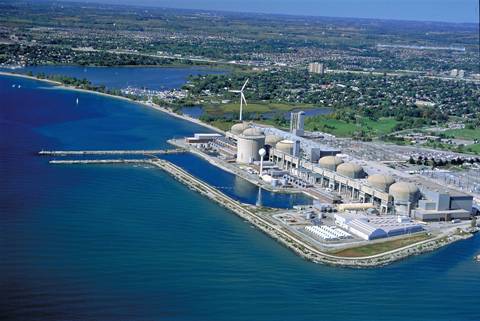
In almost all cases, nuclear reactors are built on or near natural water sources. This is because of the easy access to a cooling source. The most common coolant in a nuclear reactor is the water, referred to in the nuclear physics world as light water. Designers of nuclear reactor plants who are constrained by access to water, or believe that a better design can be obtained, look to another option for their reactor coolant: heavy water.
In this article, we will dive into what heavy water reactors are, how they work, and why they may present better advantages than the conventional light water-cooled reactor.
What is Heavy Water?
Deuterium
In contrast to light water which has a chemical makeup of one oxygen and two hydrogen, heavy water replaces the hydrogen atoms in the formula with two deuterium atoms. What is deuterium? Well, as you may know, a hydrogen atom contains just one proton and one electron. If the hydrogen absorbs a neutron, then you get deuterium. (If you add one more, you get tritium). The atomic mass of light water is 1AMU while the deuterium which carries an extra neutron is 2AMUs.
The doubled mass of deuterium actually does a better job at slowing the neutrons down in the water. This is because there is a lower probability of the water absorbing them. This is great for a reactor that requires an abundance of thermal, or slow neutrons.
How to get Deuterium
The water-hydrogen sulfide exchange (GS process) is the process for producing deuterated water (HDO). The GS process works by passing gaseous hydrogen sulfide though cold water coming in from the top.

Deuterium, which seeks stability will transport from the hotter hydrogen sulfide to the colder water as they interact. The water interfaces with hydrogen sulfide on trays and a temperature gradient forms down the tower. Until the desired purity of heavy water is obtained, the process sends water back to the top of the column as reflux. The small amount of deuterium that is left travels up the column.
Let us First Take a Look at How Light Water Is Used as a Moderator
Light Water Reactors Require Enrichment
In a conventional reactor, light water is the coolant and moderator. Light water as a coolant is good for removing heat from the reactor by generating steam for energy production. As a moderator, it does do a good job at slowing the neutrons down to create the thermal neutrons our Uranium fuel requires to react further. However, a downside of using light water is that hydrogen tends to absorb some of the neutrons from the fission reactions.
Since the reactor requires an abundance of these neutrons, the reaction slows as hydrogen absorbs them. In fact, natural Uranium which contains only 0.7% of the desired fissile isotope, Uranium235 (U235) is not able to sustain a fission reaction due to this phenomenon. This is why these nuclear reactors require the Uranium fuel to go through an enrichment process. An increased concentration of U235 leads to an increased probability of a neutron hitting the desired isotope.
The enrichment process separates Uranium isotopes out by mass in a series of very precise centrifuges. This process is expensive, leading to increased nuclear fuel costs. It also contributes to a large surplus of unwanted U238 which is collected as waste. Designers of nuclear reactors turn to considering other options to avoid these high fuel costs.
Can We Avoid Enrichment?
Heavy Water Slows Down More Neutrons
As we discussed earlier, heavy water has two extra neutrons due to its composition of deuterium as opposed to hydrogen atoms. These heavy water molecules have no desire to absorb extra neutrons. This eliminates the issue that light water reactors exhibit with neutron absorption.
The use of heavy water means that there are more thermal neutrons available to continue a fission reaction in the reactor. Since there are more thermal neutrons, the probability of reaching U235 increases significantly. In fact, there is a design of reactor with this type of moderator in mind. This reactor has a much higher neutron economy – a measure of the number of neutrons being released – that will contribute to fission with respect to the number required to maintain the reaction. In other words, heavy water allows for fission to continue with less U235.

The mitigation of high U235 isotope compositions takes place thanks to a surplus of neutrons in a HWR. Some designs of the HWR completely eliminate the need to enrich the Uranium. This means that the reactor design will end up saving money on fuel costs. It also means that there is less Uranium waste because for the most part, we use whatever we mine.
Is the Heavy Water Reactor the Right Choice in Reactor Designs?
The Benefits
Heavy water presents many benefits as it does not absorb neutrons like light water does. This contributes to a greater neutron efficiency and mitigates the need for the enrichment process (which brings dependence on Russia’s source of enriched uranium down – read more about Russia and their influence in the nuclear power industry). It also leads to less waste due to Uranium enrichment. For these reasons, the heavy water reactor has many benefits.
Heavy water reactors and light water reactors have very similar physical properties. This makes their supporting components very similar in temperature and pressure designs. However, different thermal properties arise due to different arrangements of the fuel cells.
The Negatives
Heavy water reactors also have a positive void coefficient which you can read about in our article on Chernobyl. Light water has a slightly higher thermal conductivity while heavy water reactors can operate at slightly lower pressures. This is thanks to its slightly higher boiling temperature.
Oddly enough, the heavy water reactors actually have a more difficult time creating thermal neutrons from collisions. Although they are heavier, the lack of attractive forces actually allows the neutrons to preserve more of its energy. This means that the neutrons must run into more heavy water molecules to slow down to thermal neutron speed. This means that the reactor must be larger as the neutrons must travel through more heavy water inside the reactor.
Building a larger reactor is too expensive for any plant designer to even consider. The reactor is less efficient and to make this design an economical choice, enriching the Uranium is the only other option! Though the enrichment is not as high as it is for light water reactors (2-3% instead of 3-5%), it still negates the purpose of using heavy water in the first place.
Which is Better?
Although the positives of the heavy water reactor may seem to be a better reactor design due to its efficient use of neutrons, it becomes a costly plant design regardless. Although there have been mitigations in Uranium enrichment costs, there are other costs that come up. The GS process used to produce heavy water requires a lot of energy in production as well. For this reason, a boiling water reactor would not be economical because the heavy water volume of the plant would be too large from use in the secondary side. This forces the implementation of a PWR so that the design uses light water on the secondary loop and saves on heavy water costs. This limits your plant design flexibility.

One other downside to the heavy water reactor is that it produces slightly more of a particular radioactive material during power production. While light water absorbs a larger number of neutrons to make deuterium, the odds of that same exact molecule absorbing another neutron to make tritium is near zero. Now take that near zero probability of hitting one of the very few deuterium atoms and put it in a reactor full of neutron absorbed water molecules. A significant amount of tritium comes from this process. Unfortunately, tritium is the most harmful of the byproducts in a nuclear fission process. This is due to its immense radioactivity and its small size which is impossible to contain. As there is more tritium in the heavy water reactor, there is more in the environment which poses a potential threat to workers in the plant.
So, is the heavy water reactor a good choice for reactor plant designs? The answer is… it depends. While the neutron economy, lack of Uranium enrichment, and slightly lower operating pressures may sound like reasons to choose a heavy water reactor design, light water reactors pose just as many positives. The only difference is the abundance of light water. Light water is very easy to use, predictable, and it is everywhere. Yes Uranium enrichment is a hefty task to take on, but so is heavy water production. Heavy water also poses slightly more radioactive dangers. On the other hand, light water reactors do operate at slightly higher pressures which requires more effort to control. All in all, both reactors pose advantages and are used across the world, but the light water reactor is more wide spread in society today.
We CANDU it!

There are heavy water reactors in operation today that produce significant energy for the power grid. Canada has created their version of the heavy water, the Canada Deuterium Uranium reactor – CANDU Reactor for short. Canada developed the CANDU Reactor in the 1950s and 60s and they are now in use in many different countries around the world. Though the horizontal arrangement contributes to easier control of the CANDU reactor, gravity impacts the efficiency of the reactor as the fuel assemblies and heavy water tend to the bottom of the containment. However the safety features due to this design present a lower the risk of a disaster.
The design of the reactor is much like a heat exchanger. The fuel bundles are open to allow the moderator, the heavy water to surround the assemblies. At the same time, cooling light water flows around the bundles to become heated. The horizontally assembled bundles transfer heat to the cooling water as the neutrons pass through the heavy water to become thermal. The low pressure heavy water reactor vessel itself is called a calandria.
Canada has implemented the use of this design around the world. As it is easier to work on this reactor type due to the need for less refueling, many countries were interested in using the CANDU reactor for power generation.




Leave a Reply