
Natural Uranium consists of various isotopes of Uranium ranging from Uranium-234 (U234) to Uranium-238 (U238). U238 is the most abundant source in natural Uranium with nearly 99.3% of the total composition.
In the nuclear power industry, Uranium is a necessary fuel to create the fission reaction required to generate heat. However, the isotope that is readily fissile (able to undergo a fission reaction) is Uranium- 235 (U235). This makes up most of the other 0.7% of the naturally sourced Uranium.
The design of most commonly used nuclear reactors in industry today is the pressurized water reactor, and the boiling water reactor. These designs require a higher composition of U235 to sustain a nuclear fission reaction and continuously generate power.
To achieve these higher concentrations of U235, the natural uranium is sent through what is called the enrichment process. Uranium enrichment is done in a number of ways but each method aims at separating out two isotopes that vary slightly.
Mining Uranium Ore
Mining for Uranium ore is a complex process on its own but is important to note before discussing how complex nuclear fuel is to get to its final product in the reactor.
The Uranium enriched mining sites, pipes are drilled into the ground to run gases cold enough to freeze the ground. This ensures that the rock bed is stable for mining.
Small pilot drill bits are used to create a pathway for drill shanks to fit down. The drill is used to cut through to an underground pathway where the pilot bit is exchanged for a much larger one. The drill bits are made up of steel and tungsten studs which move really fast to break up and grind down chunks of rock bed.
Once the larger drill bits are installed, the drills run vertically upward to break up the rock in its pathway. The broken ore falls to the pathway where it can be collected and measured for Uranium content. From here it is shipped to a separation facility for further processing and then finally, to the enrichment process.

Different Types of Enrichment Processes
Three ways to accomplish enriching uranium by separating out the valued isotope for use in fission reactions are:
- Gaseous Diffusion
- Gas Centrifugation
- Laser Separation
Of the three here, only one is used most frequently in industry and that is the gas centrifuge process. The gaseous diffusion process is outdated and demands a large amount of energy. The laser separation process is under development today and will hopefully be an even better option than gas centrifugation.
Gaseous Diffusion
The basis of gaseous diffusion is that particles can be separated out using porous membranes that are small enough for the unwanted particles to diffuse slowly and big enough for the desired product to pass through faster. Theoretically across an infinitely long membrane, your desired isotope would be saturated at one end and the other isotope would be at the other. When done in industry, a large enough membrane is used to pass through and obtain the precise composition of U235 desired for the nuclear reactor.
Part of the process includes taking the Uranium, which is a metal, and mixing it with hexafluoride gas. This makes it a gaseous mixture at easily attainable temperatures which can be manipulated easily in the diffusion process. From here, the gaseous Uranium-hexafluoride is compressed through hundreds of these filter membranes. At the end, the solution is enriched with U235 isotopes and is condensed down and separated at a fuel fabrication facility.

This process is effective at separating the Uranium isotopes but that was at a time when there was no other option. This process of enrichment is quite expensive due to the hundreds of precise membrane filters, compressor energy usage, and the processing of hexafluoride before and after.
Gas Centrifuge
Centrifuge technology was first used industirally to separate out fat from milk . Once centrifugal advancements led to the separation of much smaller particles, an early application was in the uranium enrichment process.
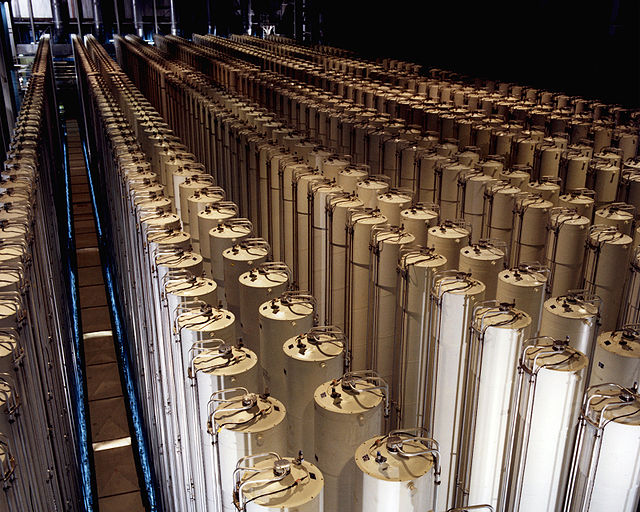
Much like gaseous diffusion, the centrifuge process separates the two isotopes of Uranium out by mass. The very sensitive centrifuges are spun at great speeds in a vacuum, allowing the heavier particles to be forced to the outside of the cylinder and the U235 to fall into the center of the vortex.

The U235 gas is extracted from the center of the centrifuge and is sent off to the next centrifuge in series to further separate out the U238. What is left after the series of thousands of centrifuges is enriched Uranium. The number of centrifuges in series can set the percent of enriched Uranium the process produces in the end.
The gas centrifuge technology consumes only about 5 percent as much electricity as the gaseous diffusion technology to produce a given amount of product (energy.gov). This makes Uranium enrichment a very accessible process for nuclear reactor projects.
Laser Separation
A technique that is undergoing a massive amount of research is enriching Uranium by separating the isotopes out by photon excitation. Now, there is the technology to excite atoms of different isotopes, a matter of 3 neutrons difference to different states and be separated out this way.
The starting Uranium hexafluoride mixture is sent into a vacuum where it becomes extremely cold (-200°C or -315°F) upon exit of the nozzle. Just out of the nozzle, laser energy is focused at the gases. U235 is just light enough to vibrate from the energy captured by the light photon of the laser while U238 aggregate and fall out of the process. The enriched Uranium is collected at the top and ready to be turned into fuel.

This is still in the research phase and the US department of energy is funding one particular company heavily to get this off the ground and in use. SILEX (Separation of Isotopes by Laser Excitation) is a company working on this technology in Australia. There is a chance that Engineering 235 can interview this company in the near future to get an inside look on their progress on the enrichment technology.
If laser technology becomes a utilized technology in the Uranium enrichment industry, then fuel costs for nuclear reactor would decrease significantly making them much more accessible to more private investors looking to create a green energy future using nuclear power.
Uranium Enrichment Has Come a Long Way

Uranium enrichment is not an easy or inexpensive process. It takes a lot of energy to achieve proper U235 compositions. However, technologies and leaders in the industry have helped to progress the access to this process to make it cheaper, easier, and more readily available. From gaseous diffusion to gaseous centrifugation and hopefully laser separation, Uranium enrichment is becoming a process that makes nuclear power all that more favorable of an option.

Leave a Reply