
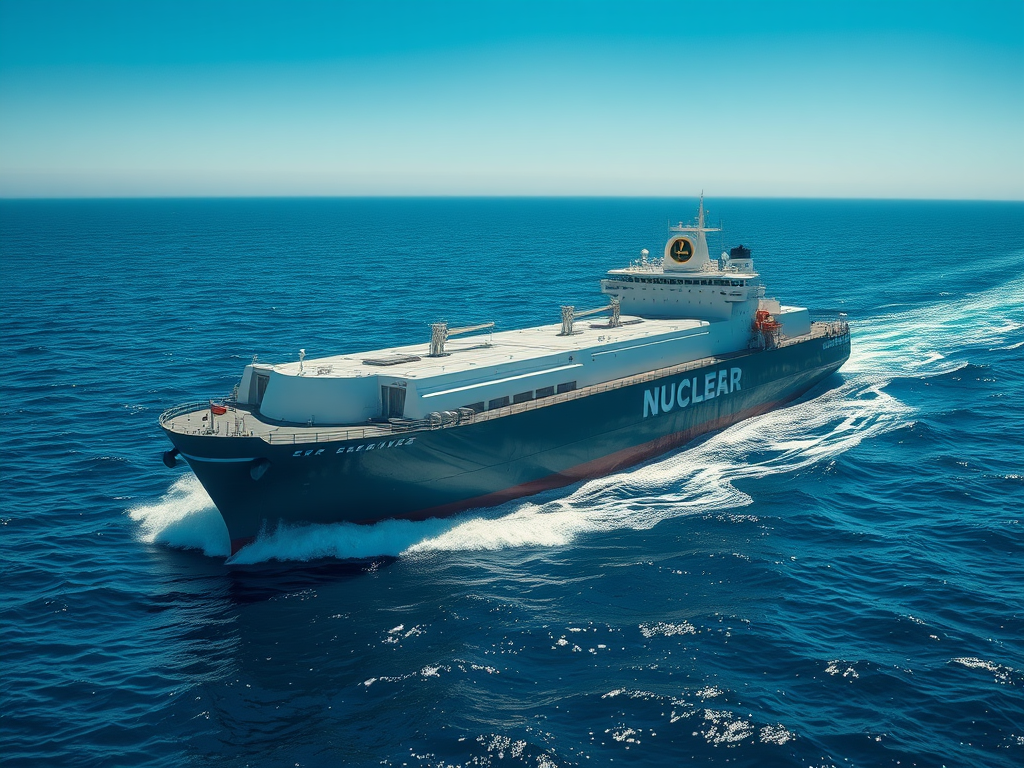
Nuclear Power – Marine Propulsion
For over 70 years, the US Navy has been patrolling the seas with nuclear energy powering their submarines. The use of this power allows the Navy to be in tactical positions due to the duration that their submarines can perform submerged. The US also found uses in aircraft carriers as it was able to remain at sea for years without refueling while food and supplies were flown out to its position. These military strategies were the main focuses of utilizing nuclear power. Now, we have other concerns that may warrant the growth of nuclear reactors at sea.

Nuclear power is now being considered in marine propulsion to fuel merchant ships for long periods of time. With the growing concern for increasing temperatures due to greenhouse gas emissions, the largely emitting transportation sector is becoming a focal point for change.
Nuclear power has proven to be an effective propulsion source demonstrated by the US navy for years. The Naval Nuclear Program was used as an example for how to create commercial plants around the US and the world. Naval nuclear vessels are used in many nations’ military as they present many tactical advantages. Their use as nuclear propelled ships has proven successful over the years.
There have been and currently are commercial nuclear powered ships trolling around the oceans. The N.S. Savannah was the first ever built as part of Dwight D. Eisenhower’s program, Atoms for Peace. Used as a demonstration for peaceful use of nuclear power and later a passenger and cargo ship, the N.S. Savannah sailed over 450,000 nautical miles all around the world before her decommission.
Other nuclear ships have been created as well. The German Otto Han was developed in 1968 and successfully traveled the world as a cargo ship for 10 years without any technical problems. It proved to be too expensive to maintain and was converted to a diesel engine ship. The Japanese Mutsu was riddled with technical and political issues and the program was deemed a complete failure.
Russia has the greatest success with their icebreaker fleet. Diesel ships used to break ice in the arctic seas were not able to be used in the winter because they could not generate enough power and constant refueling led to it not being worthwhile. The introduction of nuclear-powered icebreakers meant that they were able to discover farther reaching regions of the arctic all year round. The first of these ships was the Lenin and it remained in service for 30 years before her decommission due to hull damage. From there, an entire fleet of larger ships were deployed to accomplish the same means.

Now, there are many companies in their concept phase that aim to bring nuclear power to merchant ships today. China Shipbuilding Industry Corp (CSIC) has received approval and funding to begin developing the nuclear-powered ships. Danish shipping group Maersk is assessing the feasibility of taking this route as well. British company Lloyd’s Register and Norwegian shipbuilder Vard Group are joining in on the fun as they discuss nuclear as the only carbon-free option for energy abundance required for shipping.

There are many issues that stand in the way of commercialized marine nuclear-powered propulsion though. One thing is the negative sentiment towards nuclear power. Although this is trending in a positive direction as a new wave of advanced reactors make their way to the industry, it is still frowned upon in our open seas. Due to this negative public opinion, many governments have restricted port access for nuclear powered ships in preemptive regulatory measures.
Another issue that faces not only nuclear-powered commercial shipping but the growth of the nuclear industry as a whole is the shortage of expertise in the field. The market for nuclear power is expanding as power demands continue to rise which places pressure on the stagnant growing population of nuclear professionals. To some extent, universities are to blame in this as a majority of nuclear programs shut down over the decades. A resurgence in the field is necessary if commercialized ships are added to the nuclear scene.
The unfamiliarity in nuclear propulsion makes training operators and mechanics an extensive and expensive process. Diesel powered ships have been utilized for a very long time and it is difficult to turn this industry of workers to a much more restrictive climate in terms of plant/engine operations. New training programs will be required before growth into nuclear powered ships can happen.
Security plays a big role in any decision surrounding nuclear power, especially if it is used to traverse international waters. Nuclear power has been held as a secret from many countries as it may present a danger to the world if certain information fell into the wrong hands. Safeguarding nuclear technologies ensures that nuclear technology is used for peace and not diverted to unregulated weapons manufacturing.
Environmental risk is another key concern with having nuclear power plants floating around the world. Given the history of nuclear power, there is a concern that an accident could happen out at sea. A breach in a nuclear system would have an effect on the environment although it is difficult to determine in what ways and what magnitude. This is one of the risks that experts in the field quantify to weigh in against the many positives of nuclear power. It is impossible to fully mitigate risk in any industry, and quantifying it allows us to evaluate the proposed benefits. You never want to defend nuclear accidents; however, dilution does play an important role in helping the case for nuclear propulsion.
The combustion engine is conventional and easy to make. This allows for inexpensive shipbuilding and maintenance. On the contrary, nuclear power plants are very expensive to build and maintain. Everything from the building material to the manning of the ship, nuclear propulsion is far more expensive than diesel propulsion. It takes a lot of quantifying the benefits of nuclear power monetarily to outweigh the investment capital required upfront.
Nuclear propelled merchant ships present many positives. To start off, nuclear propelled ships would be much faster than other options available. This is favorable for shipping companies who are looking to mitigate freight times and increase the volume of exported goods, bringing in more revenue.
Nuclear power eliminates the need to refuel. This means that a ship could travel around the world many times over without stopping. More time at sea due to less port stops and mitigated fuel costs aid in generating more revenue.
Commercial nuclear propulsion would be a great steppingstone towards reaching a zero-carbon emission future. According to the U.S Environmental Protection Agency, the transportation industry is the largest contributor to greenhouse gas emissions at 28% of total emissions. Although this takes into account cars and airplanes, ships make up a portion of this.

The world is turning towards clean energy options in the midst of global warming. Commercial nuclear power in marine propulsion would be a step towards a cleaner and energy abundant future. Although there are negatives associated with this innovation, there are many benefits that may outweigh as they continue to improve nuclear safety and efficiencies. Although there are high upfront costs, these are continually decreasing as the nuclear industry grows in demand. The world of nuclear is coming fast and implementation of the technology into commercialized marine vessels would be another step towards environmental improvement.


Leave a Reply